
Africa-Asia air cargo: A fast-growing corridor looking for balance
The Africa-Asia air cargo corridor has accelerated sharply in 2026 as trade, e-commerce and investment between the two regions grow, but limited connectivity and a persistent imbalance between inbound and outbound cargo continue to constrain its development.
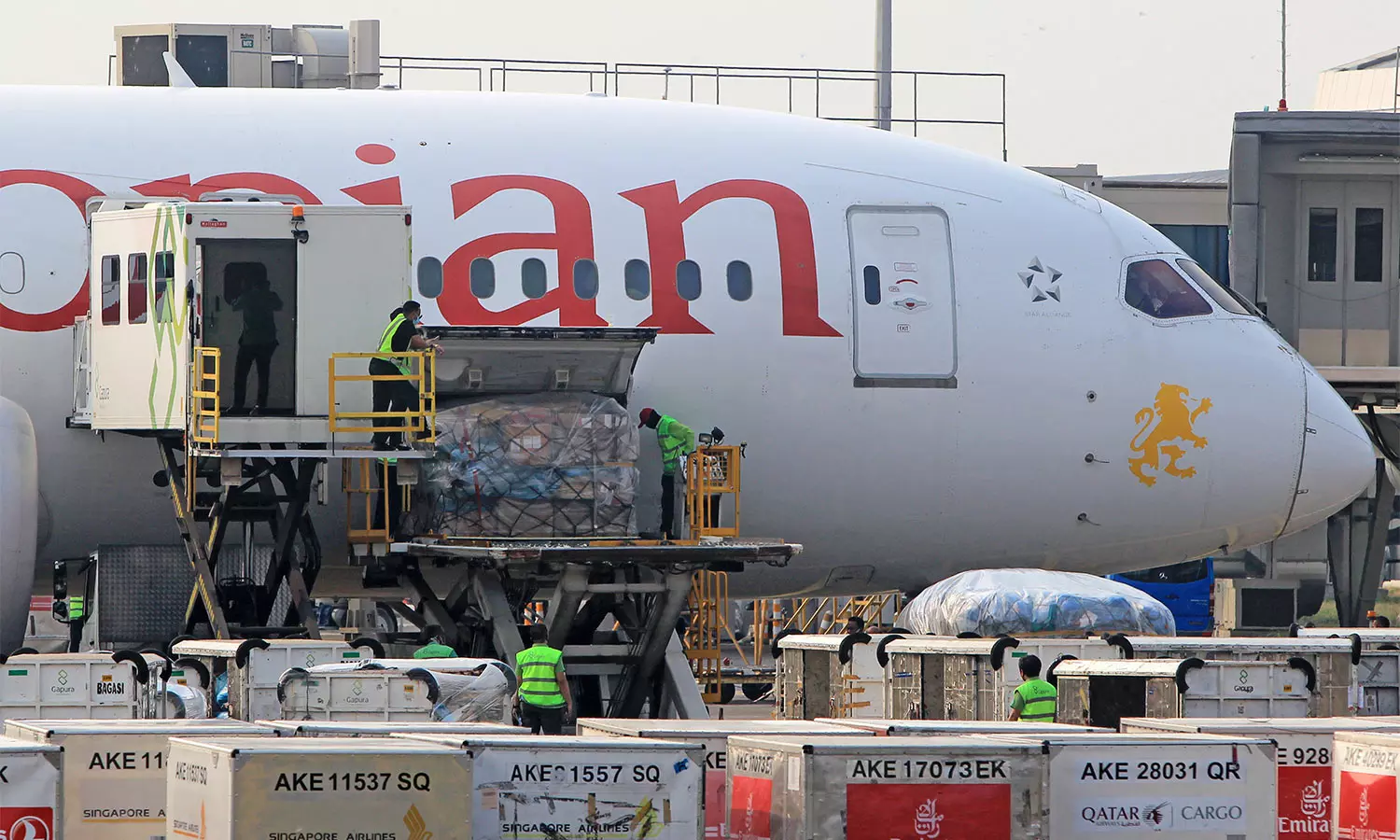
Ethiopian Airlines Boeing 787-8 Dreamliner loading cargo at Soekarno-Hatta International Airport in Jakarta, Indonesia, in August 2020.
Second only to Africa-Europe in size, the Africa-Asia air cargo corridor has emerged as one of the African continent's most important international trade lanes, more than tripling in traffic over the past decade and overtaking Africa-Middle East since 2020. In particular, the Africa-Asia air cargo trade lane has undergone a marked turnaround over the past two years, with 2026 showing a particularly strong acceleration after a weaker 2025, according to the data from the International Air Transport Association (IATA).
Cargo demand on the corridor contracted 9.6% year on year in the second quarter of 2025, partly reflecting a high base from a surge in the same period of 2024, before returning to strong growth in 2026. Demand jumped 41.6% year on year in January and 61.9% in February, before moderating to 22.6% in March, 12.8% in April and 14.1% in May, and then easing to 0.9% in June. The growth has generally outpaced capacity: in the first quarter of 2026, Africa-Asia cargo demand increased 36.2%, compared with a 16.2% rise in available capacity, pushing the cargo load factor up by nearly 10 percentage points to 62.8%. IATA has linked part of this divergence to cargo being rerouted away from disrupted Middle East routings. By June, the corridor had recorded 12 consecutive months of growth, although the pace had slowed considerably.
“Next year is a very crucial year as we're co-hosting the African Cup of Nations in May and June. We expect more flights coming into Kenya to carry passengers. That will also let us use the cargo capacity that comes with those flights.”
Lasitha Perera, EFL Global
Asia to Africa
According to Sanjeev Gadhia, Founder & CEO of Astral Aviation, the Nairobi-based cargo airline, the growth is being driven by a combination of rapidly expanding trade between Africa and Asia, particularly China, the growth of e-commerce, increased investment by Asian companies in Africa, and the need for faster supply chains for high-value and time-sensitive products.
“From our perspective at Astral Aviation, China-Africa has become one of the most promising air cargo corridors. We are seeing strong demand from Asia into Africa for e-commerce, electronics, telecommunications equipment, machinery, automotive and industrial parts, pharmaceuticals and general consumer goods.”
Astral has also expanded its China-Africa freighter network in August 2026, restarting its twice-weekly Haikou-Johannesburg service via Nairobi with a Boeing 767-300F, and resuming its Nairobi-Guangzhou operation.
There is also an important supply chain factor. He added, “African businesses increasingly source directly from manufacturers in China and other Asian markets rather than routing goods through traditional European or Middle Eastern distribution hubs. This is gradually creating a more direct Asia-Africa logistics corridor.”
Astral is not alone in expanding direct freighter links to Asia. Ethiopian Airlines has strengthened the Africa-Asia cargo corridor with new freighter links to China, adding Urumqi in June 2025 and Chengdu in August 2026 to its network, with the latter operated by Boeing 777Fs twice a week.
Meanwhile, Uzbekistan-based My Freighter is looking to deepen its footprint in Africa, opening GSA tenders in Ghana, Ethiopia, Kenya and Uganda as it seeks to develop cargo flows between Africa and Asia through its Tashkent hub.
In May 2026, EgyptAir Cargo signed a strategic cooperation agreement with Xinjiang Airport Group in Urumqi, China, to develop an air-logistics corridor between China and Africa. The airline plans to use its newly converted A330-200P2F for this route.
Logistics firm EFL Global is involved in both inbound and outbound movements on the Africa-Asia trade lane. For instance, the company handles end-to-end logistics for textile manufacturers operating within Kenya’s Export Processing Zones (EPZs), with raw materials largely moving into the country from Southeast Asia.
“Most of the raw materials for textile brands manufactured at the EPZ factories, including buttons, threads, and fabrics, are sent from Southeast Asia. We handle the first mile as well, where our Southeast Asia stations take over the cargo and bring it to Kenya,” said Lasitha Perera, Senior Manager – Business Development & Commercial, GSA Operations at EFL Global - Kenya.
The company then takes over the cargo in Kenya, moving it to factories in the country’s EPZs, before handling the subsequent export movement. “Production happens at factories, and afterwards we ship the finished goods out to the U.S. and Europe, again through EFL Global. So we provide a solution where both the first mile and the last mile are handled by EFL,” Perera said.
A similar model is emerging around solar panels, where Asian-origin products undergo value addition in Kenya before being re-exported. China is a significant source of cargo entering Kenya for EFL as well.
Solar panels currently represent one of the major commodity flows from China, alongside textile products and the components required by garment manufacturers. New product categories are also beginning to add to the inbound market. “We're seeing a massive movement of solar panels as raw material, which come in, get value addition done at factories here in Kenya, and are re-exported,” he said.
The inbound market is also broadening beyond established industrial supply chains, with consumer-oriented products gaining traction in Kenya. “You're now seeing new categories entering the African market too, like LED lights and small electronics, which are getting very popular in Kenya,” Perera said.
“Nobody flies out of Mumbai into Africa with a wide-body. For right now, it's all going back up into the Middle East on Emirates, Qatar, and Etihad, and then finding its way down into various parts of Africa on those Middle East carriers.”
David Ambridge, TAAG Angola Airlines
Beyond conventional manufacturing flows, EFL sees e-commerce as another area that could strengthen Kenya’s role in the Africa-Asia trade lane. Perera believes Kenya’s geographic position gives it an opportunity to develop into a distribution point for goods entering East Africa and subsequently moving into other African markets. “As Kenya, we need to invest in an e-commerce hub because we're the gateway into East Africa. We need to establish ourselves as a proper e-commerce distribution hub,” he said.
E-commerce remains a very important driver of Asia-Africa air cargo, particularly from China; however, Gadhia doesn't believe the future of the corridor will depend on e-commerce alone. “We are beginning to see a broader cargo mix developing. Electronics, pharmaceuticals, automotive components, machinery, telecommunications equipment and other high-value industrial products are becoming increasingly important.”
Globally, Gadhia also points out that technology cargo, particularly semiconductors, AI infrastructure, and advanced electronics, is becoming an increasingly significant driver of Asian air freight. “Africa will participate in this trend as investment in data centres, telecommunications, renewable energy and digital infrastructure increases. For airlines, diversification is healthy. A sustainable Africa-Asia corridor cannot depend on one commodity or one customer segment,” he adds.
While East Africa is building its role as a distribution point for Asian cargo, airlines elsewhere on the continent are also expanding direct China-Africa connectivity. TAAG Angola Airlines is also looking to expand its role in the growing China-Africa air cargo market. The carrier has recently launched passenger services between Guangzhou and Luanda. The operation is currently flown with a Boeing 787-9, limiting the amount of cargo that can be carried from China into Africa.
That is expected to change as TAAG introduces Boeing 777-300 aircraft on the route, according to David Ambridge, Director Cargo & Mail, TAAG Angola Airlines. The carrier initially expects one weekly flight, with plans to eventually increase the operation to three frequencies a week. "We expect to bring 10 to 15 tonnes of cargo back into Africa on every one of those flights, and eventually we'll run three frequencies a week," he said.
TAAG currently operates its lone B737-800 BCF freighter on regional routes, connecting Luanda with markets including Lagos, Brazzaville, Nairobi, Johannesburg and Lusaka. "We run seven frequencies a week with the freighter, and that feeds the regional market," Ambridge said.
Connectivity gaps
Growing trade has been accompanied by additional airline capacity, but Perera said Nairobi continues to face a capacity shortage. Some airlines have started increasing capacity into the country; Emirates and Qatar Airways are now doing three flights a day, and Etihad has gone to two flights a day,” he said.
The additional services have improved options for both sides of the trade, particularly as new connections open up access to Asian markets. “China Southern, for example, has started daily flights into Kenya from Guangzhou. These new routes and added capacity have helped both importers and exporters out of Kenya,” Perera said.
However, EFL believes the additional capacity has not yet caught up with market requirements. “So there's been a significant increase, but as Kenya, we still believe that capacity isn't enough; more needs to open up for this market,” he said.
While China is emerging as an important source market for Africa-bound air cargo, Ambridge sees a significant connectivity gap between India and Africa. He pointed to the absence of direct widebody connectivity from Mumbai to East Africa, despite the relatively short flying distance, with much of the traffic instead moving through Middle Eastern hubs. "Nobody flies out of Mumbai into Africa with a wide-body," he said. "For right now, it's all going back up into the Middle East on Emirates, Qatar, and Etihad, and then finding its way down into various parts of Africa on those Middle East carriers."
The gap is particularly relevant for pharmaceutical shipments from India, according to Ambridge, with Lagos among the African markets he sees as having significant potential. "There are huge amounts of pharmaceuticals coming out of India for Africa, and Lagos is potentially a very big market for that," he said.
There is a clear need for more direct connectivity. Gadhia also points it out clearly: “Too much Africa-Asia cargo is still routed through third-country hubs. Direct freighter services between major Asian manufacturing centres and African gateways can reduce transit times, handling risks and costs.”
“The challenge is that the volume from Asia into Africa remains considerably stronger than the return cargo from Africa into Asia. Developing sustainable backhaul cargo is therefore one of the biggest opportunities for the industry.”
Sanjeev Gadhia, Astral Aviation
Africa to Asia
Even though the demand on the lane remains strong, the trade remains quite directional. As Gadhia puts it, “The challenge is that the volume from Asia into Africa remains considerably stronger than the return cargo from Africa into Asia. Developing sustainable backhaul cargo is therefore one of the biggest opportunities for the industry.”
“It is relatively easy to fill a freighter from Asia into Africa. The challenge is finding sufficient high-value cargo for the return sector. Without stronger backhaul volumes, airlines either operate with lower load factors or have to price the stronger direction sufficiently high to compensate for the weaker return sector.”
From Africa to Asia, the air cargo commodities include mostly perishables, seafood, flowers, fruits and vegetables, minerals and precious or semi-precious products, as well as specialist agricultural commodities. Kenya’s horticultural exports are also moving into Asian markets, although the destination mix for flowers has changed in recent years. “There are a lot of flowers moving out of Nairobi into these markets. China was a big market a couple of years ago. China has started producing its own roses, so there's been a dip in that market,” Perera said.
Demand remains for Kenyan horticultural products in other Asian destinations, including Singapore and Malaysia, while Southeast Asian hubs are also playing a role in Kenya’s flower exports to Australia. “For other Southeast Asian destinations like Singapore and Malaysia, there's demand for our pineapples, avocados and mangoes. And there's heavy flower movement into Australia, using these Southeast Asian countries as transit hubs,” he said.
Japan has become a particularly important destination for Kenya’s flower exports, according to Perera, with EFL handling regular shipments into Tokyo’s two major airports. “Our biggest market for flowers right now is actually Japan — a lot of flower movement goes into Narita and Haneda,” he said.
According to Gadhia, Africa needs to develop more export-ready products for Asian markets, particularly perishables, seafood, meat, flowers, fruits and vegetables, pharmaceuticals, minerals and value-added agricultural products. “At the same time, we need better cold-chain infrastructure, more efficient customs processes, digital cargo systems, competitive airport charges and greater cooperation between governments, airlines, airports, freight forwarders and exporters.”
The long-term opportunity is to move from an Asia-to-Africa cargo lane into a genuine Africa-Asia trade corridor. That means aircraft flying into Africa with e-commerce, technology and manufactured products and returning to Asia with African perishables, agricultural products, minerals and other high-value exports.
Meanwhile, Ambridge expects the imbalance between China and Africa to remain a defining feature of the air cargo trade lane, with China predominantly serving as an export market and African countries primarily importing goods. "China is an export market; Africa, predominantly, is an import market," he said. "What's coming over is tonnes and tonnes of e-commerce for places like South Africa and Nigeria, not so much into Angola, where e-commerce is still very much in its infancy," he said.
The China-Angola flow also includes consumer electronics, including computers, laptops and mobile phones. Seasonal product launches can quickly absorb available aircraft capacity. "Especially at this time of year, when they're launching the iPhone 18, it's a busy time; air cargo capacity gets filled up pretty quickly whenever Apple does a new launch," he said.
2027 and beyond
The Africa-Asia corridor subsequently lost momentum, with year-on-year growth slowing to just 0.9% in June and then turning into a 1.8% contraction in July, according to IATA, marking a sharp reversal.
However, Gadhia describes this more as a normalisation after exceptionally strong growth rather than a fundamental weakening of the Africa-Asia opportunity. “We are also seeing some moderation in e-commerce growth, changing customs and de-minimis regulations in major global markets, softer export orders, and continuing geopolitical and capacity disruptions affecting routes through the Middle East.”
“But the underlying fundamentals remain attractive,” Gadhia doubles down. “Africa has a young population, expanding consumer markets and growing digital adoption, while Asia remains one of the continent's most important sources of manufactured goods, technology and investment.”
Perera expects 2027 to bring an additional boost to Kenya’s aviation market, with the country preparing to co-host the Africa Cup of Nations, the biennial international men's association football competition in Africa, in June and July. “That will bring in a lot of tourists, so we expect more flights coming into Kenya to carry passengers,” he said.
The expected increase in passenger traffic could also expand belly-hold cargo capacity on services to and from Kenya, creating additional freight opportunities. “That will also let us use the cargo capacity that comes with those flights, both into and out of Kenya,” he said.
For the Africa-Asia corridor to mature into a truly two-way trade lane, the next phase will depend not only on more Asian imports into Africa, but also on building the infrastructure, connectivity and export base needed to fill the aircraft on the return journey.
The article was originally published in the September-October 2026 issue of Logistics Update Africa.