
How Africa is reshaping its role in global air freight
Once dominated by seasonal exports and inbound supplies, Africa’s air cargo market is undergoing a structural shift in how it serves global trade.
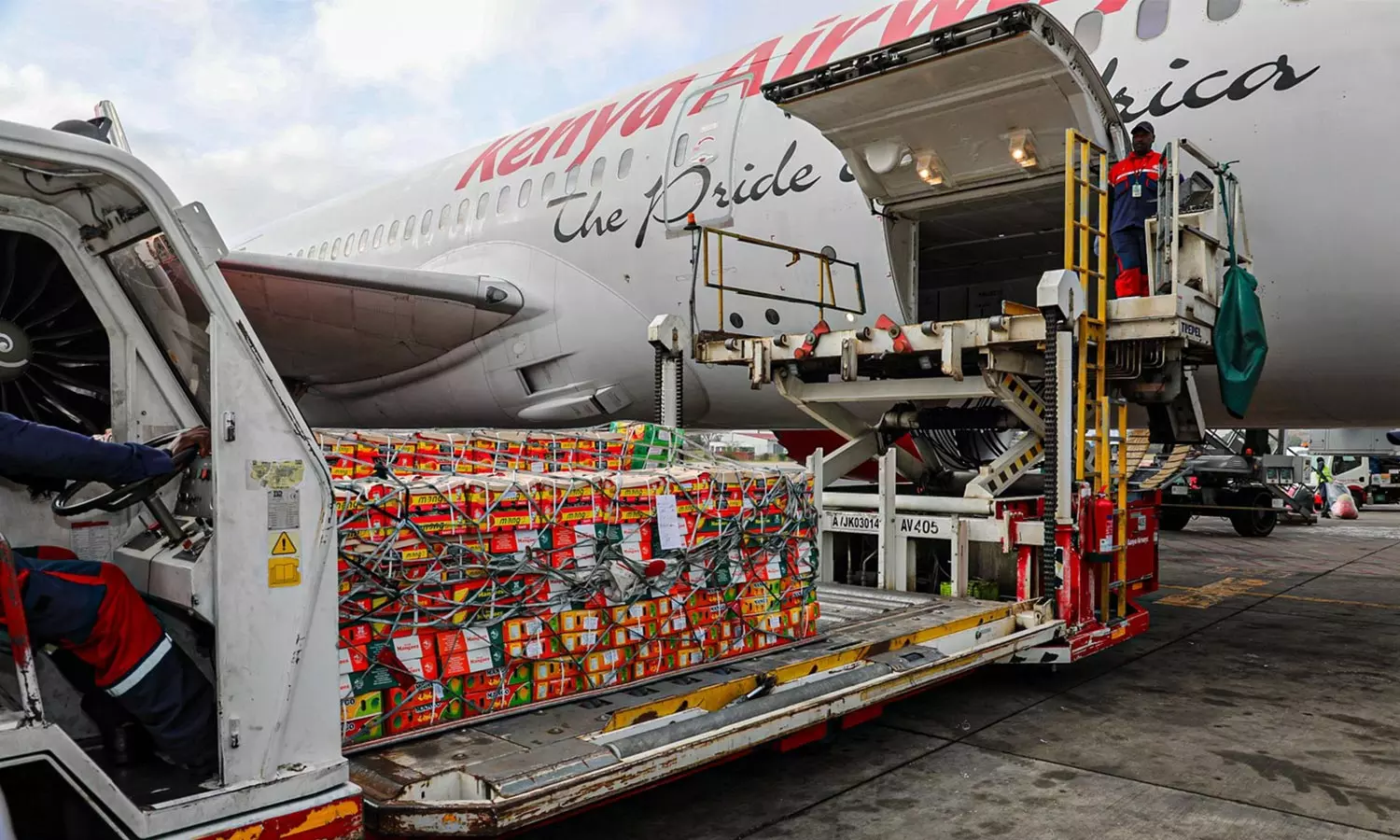
Kenya’s pilot apple mango export to the UK
Africa’s air cargo market is now balancing high-value, time-critical pharmaceutical shipments with large-scale perishables trade that depends on speed and cost discipline. This convergence is forcing a rethink of how cargo is routed, handled and scaled, as African gateways adapt to function not only as export points but as integral links in international supply chains.
“Africa’s air cargo sector is at a turning point. Pharmaceutical volumes are surging, driven by healthcare investment and vaccine distribution, while perishable flowers, fresh produce and seafood remain vital export pillars. Airlines, ground handlers and logistics providers are recalibrating strategies to manage these flows, focusing on network design, capacity planning and operational execution at key gateways,” says Fitsum Abadi Gebrehawaria, Managing Director of Cargo at Kenya Airways.
That recalibration is visible across Africa’s main cargo gateways. Airports such as Nairobi, Addis Ababa, Johannesburg and Lagos are no longer viewed simply as export points but as nodes within increasingly complex supply chains linking Africa with Europe, Asia and the Middle East.
Cargo growth data reflects this shift. According to the International Air Transport Association (IATA), African carriers delivered some of the strongest air cargo demand growth among global regions in 2025. In November 2025, Africa’s air cargo demand surged 15.6 % year-on-year, while available cargo capacity for African airlines expanded 18.1 % over the same period, the fastest regional rise reported by IATA.
Redrawing the cargo map
Network design has moved to the centre of strategic decision-making for African air cargo operators. For years, cargo networks were shaped largely by passenger schedules and a heavy reliance on Europe-bound perishables. That model is now being redrawn as cargo flows diversify by destination and value.
Africa–Asia trade lanes have emerged as a key growth driver. IATA data shows that air freight volumes on the Africa–Asia corridor grew by about 9.5 per cent year-on-year in November 2025, continuing several months of expansion and outpacing several traditional long-haul markets..
The faster expansion of Africa–Asia flows is reinforcing the case for new routings, frequency adjustments and greater reliance on hubs capable of supporting multidirectional cargo movements, particularly for pharmaceuticals and high-value imports into Africa.
Fresh produce remains the dominant outbound cargo from East Africa, especially flowers, fruits and vegetables. Yet the economics of perishables remain unforgiving. Margins are thin, seasonality is pronounced and reliability is critical. “Fresh produce requires seamless cold chain solutions, but thin margins make freighter operations challenging,” Gebrehawaria says. “Partnership is not a choice; it is a necessity for African airlines.”
As a result, collaboration has become central to network resilience. Interline agreements, block space partnerships and shared freighter capacity are increasingly used to stabilise lift during peak export seasons. The recovery of passenger widebody fleets through 2024 and 2025 has also restored belly capacity on long-haul routes, easing pressure on exporters that had relied heavily on charters during the pandemic years.
Even so, structural imbalances persist. According to IATA’s regional air cargo data, carriers from Africa accounted for roughly 2% of global cargo tonne-kilometres (CTKs) in 2024, highlighting the region’s small share of world air cargo capacity despite its population size and growing healthcare logistics needs. Routes capable of accommodating both high-value pharmaceutical shipments and time-sensitive perishables, including avocados and cut flowers, are prioritised, while thinner markets are consolidated through hub operations.
Swissport's ramp handling at Nairobi’s JKIA cargo terminal
When operations define competitiveness
As networks expand, the focus is shifting from simply adding capacity to ensuring operational reliability. For pharmaceuticals and perishables alike, integrity is non-negotiable. A delay on the ground or a temperature deviation can erase the value of an entire shipment.
“Pharmaceutical shipments demand temperature-controlled environments and predictable schedules, while perishables require speed and freshness,” Gebrehawaria says. “Yet Sub-Saharan Africa receives only a small share of global air cargo capacity, despite being home to over 1 billion people and facing high healthcare logistics needs. Industry estimates suggest that up to 90 per cent of essential pharmaceuticals arrive by air, making capacity constraints a critical issue.”
Airlines and airports are responding with targeted investments. Kenya Airways Cargo has developed a 600-square-metre dedicated pharmaceutical handling facility at Nairobi’s Jomo Kenyatta International Airport, designed to support active containers, real-time temperature monitoring and compliance with WHO and EU Good Distribution Practise standards. The facility is CEIV certified and geared towards handling vaccines, oncology drugs and biologics.
“Pharma air cargo is growing steadily across Africa as demand for medicines rises,” Gebrehawaria says. “We’re seeing strong growth in cold chain cargo, particularly in East Africa.”
Such investments are reshaping competition between African gateways. Handling capability is becoming a differentiator rather than a support function. Ground handlers are deploying advanced refrigeration systems, digital tracking tools and tighter process controls to reduce dwell times and manage exceptions.
However, reliability challenges extend beyond airport boundaries. First-mile infrastructure remains a weak link for perishables. “While JKIA has advanced facilities, first-mile cooling and rural cold storage remain underdeveloped, leading to post-harvest losses of up to 40 per cent for some products,” Gebrehawaria notes.
Inland logistics costs compound the problem. Poor road conditions, congestion and limited multimodal connectivity raise transport costs and increase spoilage risk. Regulatory processes also continue to slow cargo flows during peak periods, particularly for agricultural exports subject to phytosanitary inspections. These constraints underline the need for coordinated public-private investment in cold storage, digital customs systems and road-air connectivity.
Partnership is not a choice; it is a necessity for African airlines.
Fitsum Abadi Gebrehawaria, Kenya Airways
Trade shifts reshape demand
Beyond infrastructure and operations, broader market forces are reshaping Africa’s air cargo outlook. E-commerce growth, healthcare logistics and regional trade integration are altering demand patterns and influencing long-term capacity decisions.
Data from Xeneta indicates that global air cargo demand remained resilient through 2025, growing by around 4 per cent despite weaker signals from some cross-border e-commerce segments. While volumes linked to fast fashion and low-value consumer goods softened, demand for high-value and time-critical cargo continued to support air freight markets.
For Africa, this has translated into a more balanced cargo profile. Perishables remain central, but growth is increasingly driven by pharmaceuticals, medical devices and higher-value consumer goods. “The most influential shift has been the rise of e-commerce and high-value pharma shipments, alongside sustained perishables demand,” Gebrehawaria says. “Africa’s e-commerce market is projected, according to industry forecasts, to grow at a CAGR of about 8.46 per cent and reach roughly 56 billion dollars by 2029, creating new demand for rapid air freight services.”
These shifts are prompting airlines to refine fleet strategies. Freighters are being deployed more selectively, belly capacity is being optimised for yield rather than volume, and hubs such as Nairobi are increasingly positioned as regional distribution centres rather than single-origin points. In parallel, the African Continental Free Trade Area is expected to stimulate intra-African trade over time, supporting shorter-haul air cargo networks and more frequent services.
Sustainability is also entering the equation. Cold chain operations are energy-intensive, and cargo customers increasingly expect transparency on emissions and compliance. Investments in newer aircraft, more efficient ground equipment and sustainable aviation fuel initiatives are beginning to influence cargo strategies, particularly in the pharmaceutical sector.
A sector at a crossroads
Africa’s air cargo sector is no longer defined solely by its constraints. Strong demand growth, expanding trade links and targeted infrastructure investment are positioning the continent as a more integral part of global air freight networks. The path forward, however, will depend on how effectively network design, operational integrity and market strategy are aligned.
As Gebrehawaria observes, “Recent demand shifts are reshaping cargo strategies across global trade lanes, positioning Africa as a critical node in international supply chains.”
The next phase will be shaped not just by tonnes moved, but by how well Africa balances pharmaceutical precision with perishable speed and how confidently it embeds itself within global air cargo flows.
The article was originally published in the January-February 2026 issue of Logistics Update Africa.