
Strong production, tight lift: Kenyan flowers head into Valentine’s Day
As Valentine’s Day approaches, Kenya’s flower export industry enters its annual peak with stronger production outlooks, but persistent air cargo capacity, pricing and airport constraints are shaping how much demand can actually move.
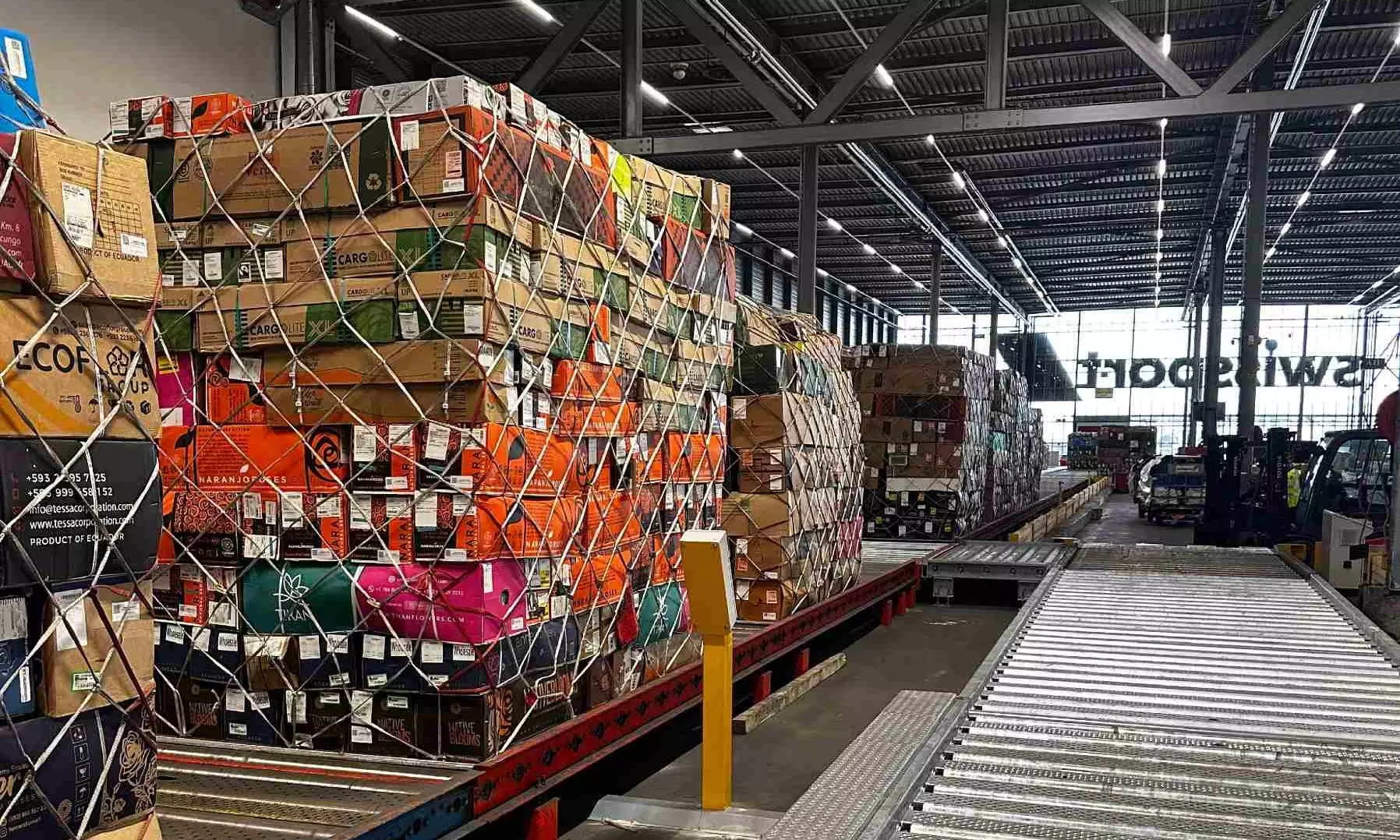
Source: Swissport
As Valentine’s Day of 2026 approaches, Kenya’s flower export supply chain is once again operating under a familiar paradox. Production outlooks are broadly positive, demand remains resilient across core markets, and yet the system remains vulnerable to capacity mismatches and operational choke points that surface every peak season. For exporters, the weeks ahead are less about whether flowers will be grown and more about whether they can be moved efficiently through an air cargo system that still lacks seasonal elasticity.
The global cut flower market was valued at about $35 billion in 2025 and is projected to nearly double to roughly $61 billion by 2035, according to an Astute Analytica report, driven by sustained consumer spending on gifting occasions and rising commercial demand across key importing regions. Within this broader context, Kenya remains a significant exporter, having shipped 102,500 tonnes of flowers in 2024, including 66,688 tonnes in just the first half, and earning roughly KSh 108 billion (about $835 million) in foreign exchange from floriculture.
The weather has played a defining role in shaping expectations this year. Across Kenya and Ethiopia, growing conditions have supported stronger output compared to the previous season, raising confidence around availability. But that headline improvement masks a more complex reality on farms. “We have very hot days and very, very cold nights across the country,” says Calvine Emadau, Commercial Manager at Karen Roses. That wider temperature range slows physiological growth, stretching crop cycles beyond planned timelines. As Emadau explains, when nights are too cold, “the process of growing almost stops,” meaning volumes intended for peak windows may arrive later than expected.
Demand, however, has not eased to match those shifts. According to Emadau, customer orders are “stable, maybe four or five percent higher than last year,” reflecting sustained consumption in Europe, the Middle East and parts of Asia. Valentine’s Day, International Women’s Day, and upcoming Middle Eastern festivities are once again compressing demand into a narrow corridor, intensifying pressure on logistics rather than production. The concern among buyers, he notes, is not whether flowers will be available, but “whether they’re able to order” with confidence given freight uncertainty.
“The challenge is not production but securing freight space, especially to the Middle East and the Far East, because capacity has not adjusted to reflect the peak.”
Calvine Emadau, Karen Roses
That uncertainty is most acute on air cargo routes to the Middle East and the Far East. While Europe remains relatively balanced, lift on other lanes has not expanded in line with seasonal volumes. “The capacity seems to be liftable, but the demand is higher,” Emadau observes, adding that airlines have not adjusted capacity to reflect the peak. Freight rates have risen accordingly, with some customers reporting sharp spikes, though the situation remains more contained than during previous crisis years. In this environment, access to space increasingly depends on negotiation strength and long-standing relationships with forwarders.
Airport operations represent another pressure point. Karen Roses has sufficient cold storage, trucking capacity and farm-level readiness, but Emadau warns that congestion at Nairobi’s Jomo Kenyatta International Airport (JKIA) could still disrupt flows. During peak delivery days, he expects the risk of temporary restrictions, where farms may be asked to hold product back to manage congestion. If even a small link in the chain breaks, he cautions, congestion “will be massive,” underscoring how tightly coupled production and uplift remain during Valentine’s week.
Yet not all exporters experience these pressures in the same way. Lenana Flowers, a specialist chrysanthemum grower, illustrates how crop characteristics and commercial terms shape logistics exposure. Chrysanthemums are structurally more resilient than roses, allowing longer cold storage without quality loss. “I can keep it easily a week in the cold store, and it’s still good for the client,” says Director Jeroen Marrewijik. Combined with Free on Board (FOB) sales terms, this shifts freight responsibility to buyers and insulates the farm from downstream disruptions. “If I deliver it at the airport, my work is done,” he says.
This model fundamentally alters how Valentine’s Day is approached. For Lenana Flowers, the occasion represents only a moderate production peak. “We go from around 300,000 stems a week to about 375,000 for two weeks,” Marrewijik explains, a roughly 20–25 percent increase. More significant peaks occur later in the season, driven by Middle Eastern demand linked to Ramadan, Eid and Saudi Mother’s Day, which in some years exceed Valentine’s volumes. This market orientation explains why air freight remains dominant and why sea freight, despite its cost and sustainability appeal, has not gained traction.
“If the client prefers sea freight, I would have to change my varieties and my whole planning, that’s not something you do overnight.”
Jeroen Marrewijik, Lenana Flowers
Marrewijik is clear that sea freight would require a fundamentally different operating model. “I also have to change my assortment and grow varieties that are suitable for sea,” he says, noting that this would only make sense with standing orders and long-term contracts from large retail buyers. Without that certainty, the risk sits squarely with the grower. “That’s not an overnight decision,” he adds, highlighting the cyclical nature of chrysanthemum planting and harvesting, where changes must be planned months in advance.
Karen Roses, operating at a larger scale and with a more diversified market base, has taken a different approach. While air freight dominates Valentine’s flows, the company has cautiously reintroduced sea freight to Europe in partnership with shipping lines that can guarantee cold chain integrity. “It works perfectly well, provided the cool journey is maintained,” Emadau says. However, volumes remain limited, constrained not by technical feasibility but by buyer commitment. Scaling up, he notes, requires customers willing to absorb three to four hundred thousand stems per cycle, volumes that demand confidence across the entire chain.
Despite these differences, both exporters converge on the same structural insight: modal shifts and logistics optimisation cannot be driven by growers alone. They require aligned incentives, predictable demand and shared risk between buyers, logistics providers and producers. Freight cost reductions or sustainability arguments, on their own, are insufficient to rewire peak-season behaviour.
That system-wide coordination becomes most visible when viewed from the freight forwarder’s position at the centre of Valentine’s execution. For DSV/ DB Schenker, preparation does not begin in January, but months earlier, when volumes are still being forecast, and airline space can still be influenced. “The planning starts months in advance for Valentine’s,” says Harm-Jan Mostert, Commercial Director Perishables at DSV/ DB Schenker.
“In many cases, a slightly higher but reliable rate or allocation is more economical than a cheaper booking that carries delivery risk.”
Harm-Jan Mostert, DSV/ DB Schenker
Early forecasting is conducted across internal teams, customers, and airline partners, allowing space to be locked in well before demand peaks. Rather than relying on the spot market, the forwarder secures pre-allocated capacity with key carriers serving Nairobi, deliberately spreading risk across multiple airlines and routings to avoid dependence on a single operator.
This advanced positioning is increasingly critical as peak-season pricing dynamics intensify. According to Mostert, Valentine’s airfreight rate increases follow a familiar pattern, driven by “limited available wide-body capacity, fuel price and cost pressures at the airline level, and high demand.” For exporters operating on tight margins, this creates a difficult trade-off. Yet, as he points out, “in many cases, a slightly higher but reliable rate or allocation is more economical than a cheaper booking that carries delivery risk.” In a market where missing a delivery window can erase an entire shipment’s value, certainty has become a cost worth absorbing.
Execution at origin remains a decisive factor. DSV/ DB Schenker places heavy emphasis on coordination between farms, packhouses, exporters, and the airport to ensure flowers arrive within narrow temperature windows. This discipline reduces dwell time and lowers the risk of congestion-related delays once volumes surge through JKIA. Temperature control, Mostert stresses, must be end-to-end, supported by strict monitoring and “clear escalation protocols if temperature deviations occur,” particularly during peak days when recovery options are limited.
Visibility and communication are equally central. Proactive milestone tracking and early warning signals allow corrective action before disruptions escalate. Just as important is the human element: “dedicated perishable teams that understand flower season dynamics, not generic cargo handling,” Mostert notes. These teams are supported by local staff at both origin and destination who are empowered to make real-time decisions when conditions shift.
Contingency planning, however, is what ultimately separates peak-season resilience from failure. DSV/ DB Schenker pre-plans alternative routings and carrier options and retains the ability to split volumes when necessary to protect delivery timelines. When disruptions occur, Mostert emphasises, what shippers value most is not price competitiveness but consistency. “In peak season, all players value a partner who can execute consistently with good service, not just offer attractive rates,” he says.
Valentine’s Day logistics have evolved into a precision exercise that rewards preparation more than scale. Strong production and resilient demand offer reassurance, but success is ultimately determined by how well forecasting, capacity commitments, temperature control, and decision-making are aligned across the chain. As Kenya’s flower exports grow more diverse in markets and more demanding in execution, peak seasons will increasingly test not just infrastructure, but coordination itself.