
Zipline's 13X growth fuels US expansion, new hires
Drone delivery leader adds Tesla, Waymo, Uber veterans to C-suite as it preps healthcare launch in Cleveland and food delivery in Austin.
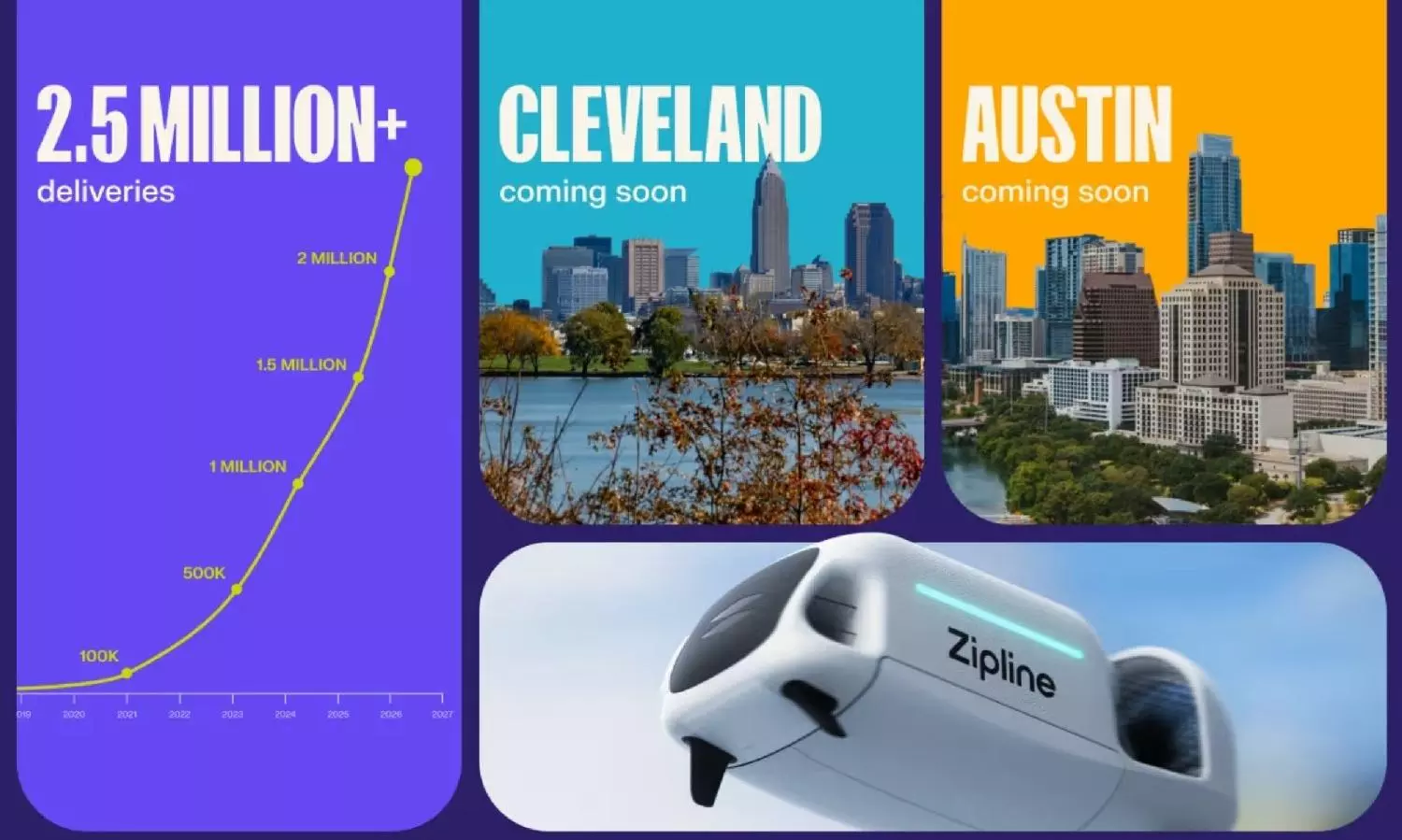
Zipline is doubling down on the US market, with upcoming launches announced in Cleveland and Austin. The autonomous delivery company has also strengthened its leadership team by hiring three senior executives, as it reports a 13-fold surge in businesses offering delivery through its app during the first half of 2026.
The company has now completed more than 2.5 million commercial deliveries. One million of them in the last 12 months alone. Zipline runs more flights per day than major US airlines. Every flight is fully autonomous. Roughly 70% of them fly over American skies.
Cleveland and Austin join the network
Zipline’s first US healthcare home delivery push launches this month with Cleveland Clinic, starting in the Beachwood suburb. Eligible patients can opt in to receive prescription deliveries at home — no extra cost. The program will expand over time to cover lab samples, medically tailored meals, medical and surgical supplies, and hospital-at-home materials moving between Cleveland Clinic facilities.
Food and retail delivery lands in Austin in the coming months. Local businesses will reach customers in as little as five minutes through the Zipline app — the same five-minute promise driving adoption elsewhere in Texas.
Business adoption accelerates
The 13-fold growth in participating businesses spans national chains and local favourites alike. Chipotle delivers through Zipline. So do Anothai Cuisine in Houston and Amelia's Cocina Mexicana in Rowlett. Wonder will bring Zipline delivery to 50 upcoming Texas food halls. Little Caesars is scaling from five locations to 65. New businesses sign on every week.
The world's largest drone delivery network
Zipline positions itself as the world's largest and most experienced drone delivery service. The company operates zero-emission aircraft across four continents, completing a delivery somewhere in the world every 20 seconds and serving more than 5,000 hospitals and health facilities. With over 135 million autonomous commercial miles flown to date, Zipline is reshaping access to healthcare, consumer goods, and food. The company says its customers depend on it to save lives, save time, expand economic opportunity, and deliver logistics at scale.
Three hires, three industries
Zipline built out its leadership bench to match the growth curve.
Sendil Palani joins as Chief Financial Officer after 17 years at Tesla, where he most recently served as Vice President of Finance. He joined Tesla when the company built just one vehicle a day and helped steer its financials through global expansion. "This is a special opportunity to help save and improve lives globally, while reducing cost and energy use at scale," Palani said.
Kevin Vosen becomes Chief Legal Officer after nearly seven years in the same role at Waymo. He most recently served as Chief Administrative and Legal Officer at Ohalo. "Zipline's next chapter is about making its experience accessible to communities worldwide while continuing our track record of safe, trusted operations," Vosen said.
Allen Penn takes over as Head of Commercial. He helped grow Uber from 25 employees to more than 25,000, led its expansion across Asia, and ran global operations at Uber Eats. Penn now owns Zipline's commercial strategy as the company scales.
Allen Penn, Sendil Palani, and Kevin Vosen
A decade of numbers behind the momentum
Zipline's medical deliveries save more than 12,000 lives a year; more than 60,000 lives saved to date. Childhood deaths from severe malnutrition are down 22% in areas it serves. Maternal mortality is down 51%.
The safety record backs the expansion case. Zipline has flown more than 135 million commercial autonomous miles and delivered 20 million items without a safety incident. That's the equivalent of driving every road in America 32 times over, a distance that would typically produce more than 600 crashes, over 100 injuries, and at least one fatality. Some Zipline aircraft have logged more than 1 million miles each; the average US car covers 150,000 miles in its lifetime.
Zipline spent a decade proving autonomous delivery works. Now it's scaling, more businesses joining the network, more customers using it daily, and a leadership team built to take the model to millions more people.