
Egypt advances 33 dry ports plan as Suez Canal rebounds
In early 2026, Suez Canal recorded 1,315 ships, 56mn tonnes and $449mn, up from 1,243 ships, 47mn tonnes and $368mn during the same period last year.
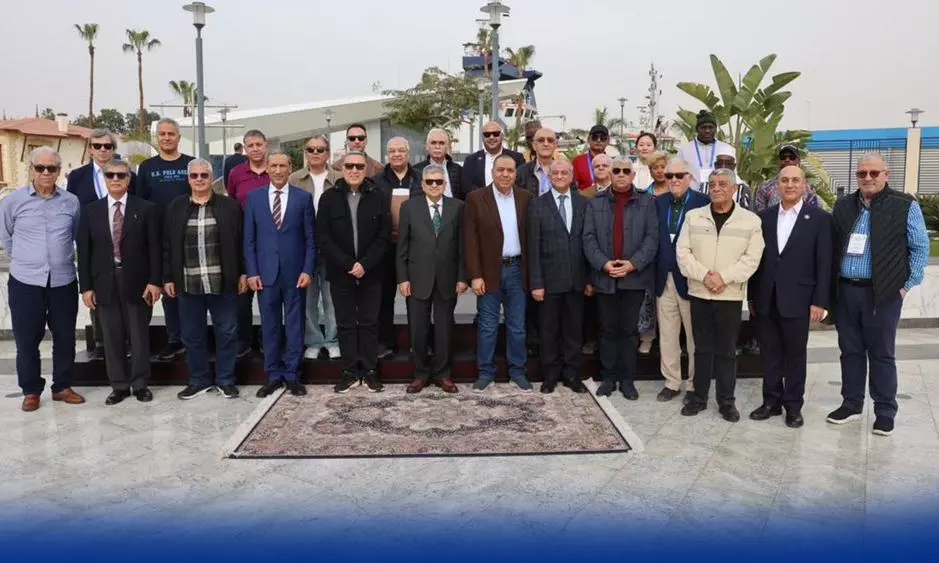
Ossama Rabiee, Chairman of the Suez Canal Authority, receives Counsellor Paulos Fahmy Iskander, President of the Supreme Constitutional Court, and a delegation of African judicial leaders and EU observers at the Authority’s Maritime Training and Simulation Academy in Ismailia.
Egypt is accelerating the development of smart and resilient logistics corridors, with plans to establish 33 dry ports and logistics zones nationwide, as part of a broader strategy to strengthen supply chains, enhance multimodal integration, and position the country as a regional transport and transit trade hub linking Africa, the Mediterranean and global markets.
The plans were outlined by Deputy Prime Minister for Industrial Development and Minister of Industry and Transport Kamel El Wazir during the inauguration of the 15th International Maritime Transport and Logistics Conference (MARLOG) in Alexandria, organised by the Arab Academy for Science, Technology and Maritime Transport (AASTMT).
Addressing delegates, Wazir said holding the conference under the theme “Smart and Resilient Logistics Corridors: Future Gateway to the Green Trade” reflects growing recognition that the future of global trade depends on efficient, flexible and sustainable logistics systems.
He noted that recent global disruptions have demonstrated the urgent need for corridors built on digital transformation, integration of transport modes and modern technological solutions to ensure trade continuity, reduce risk and lower environmental impact.
Wazir said Egypt’s Ministry of Transport, acting on directives from President Abdel Fattah El-Sisi, is prioritising the development of maritime transport and logistics infrastructure to transform Egypt into a regional and global hub for transport, logistics and transit trade.
شارك الفريق أسامة ربيع رئيس هيئة قناة السويس، اليوم الأحد، في افتتاح فعاليات المؤتمر السنوي الدولي للنقل البحري واللوجستيات (مارلوج) في نسخته الخامسة عشر، والذي تنظمه الأكاديمية العربية للعلوم والتكنولوجيا والنقل البحري تحت رعاية جامعة الدول العربية وبالتعاون مع وزارة النقل، خلال… pic.twitter.com/FLFSyvF15i
— هيئة قناة السويس Suez Canal Authority (@SuezAuthorityEG) February 8, 2026
He explained that the country’s transport corridors are designed to link seaports on the Red Sea and the Mediterranean, the Suez Canal axis, dry ports, logistics zones, industrial and agricultural production areas, railway networks and express highways. The objective is to achieve full integration between different modes of transport while improving overall supply chain efficiency.
A central pillar of this strategy is the implementation of a comprehensive plan to establish 33 dry ports and logistics zones across Egypt. According to Wazir, these facilities will serve industrial areas and ensure their integration with associated transport modes, strengthening inland connectivity and reducing congestion at maritime gateways.
The conference also highlighted the performance and strategic direction of the Suez Canal Authority (SCA), a critical artery for African and global trade flows.
Ossama Rabiee, Chairman and Managing Director of the Suez Canal Authority, said: “The Suez Canal has reintroduced itself as an advanced logistical system adopting digital transformation”.
He added that the Canal “has become a global symbol of resilience in the face of extreme challenges,” referencing a series of disruptions over recent years, including the COVID-19 pandemic, the grounding of EVER GIVEN, the Russian-Ukrainian war and the Red Sea navigation crisis.
Rabiee noted that the first half of the fiscal year 2025/2026 recorded a 5.8% increase in the number of transiting vessels and a 16% rise in net tonnage, leading to an 18.5% increase in revenues compared to the same period of the previous fiscal year.
Since the beginning of 2026, 1,315 vessels have transited the Canal, representing a total net tonnage of 56 million tonnes and generating revenues of $449 million. This compares to 1,243 vessels, 47 million tonnes and $368 million during the same period last year.
Rabiee also outlined infrastructure and operational upgrades under the SCA’s 2030 Development Strategy, including the completion of the Southern Sector Development Project, which increased navigational safety by 28%, alongside the introduction of new services such as crew change, water ambulance and maritime salvage operations.
He said the Authority’s shipyards and affiliated companies are expanding domestic maritime manufacturing capacity under the “Made in Egypt” initiative, including the recent signing of a contract to export two tugboats to the Italian company NERI.
For Africa’s broader logistics landscape, Egypt’s push to integrate seaports, dry ports, railways and road networks, combined with the Suez Canal’s digital transformation and operational recovery, reinforces the country’s ambition to act as a gateway between African production centres and global trade corridors.
The MARLOG conference brought together regional transport ministers, maritime authorities, logistics experts and international stakeholders to discuss the future of smart, resilient and green trade corridors amid shifting geopolitical and economic dynamics.