
AD Ports explores investment in Romania’s Constanta Port
The agreement leverages the Black Sea’s largest port to strengthen Middle Corridor trade flows from China to Europe via Central Asia.
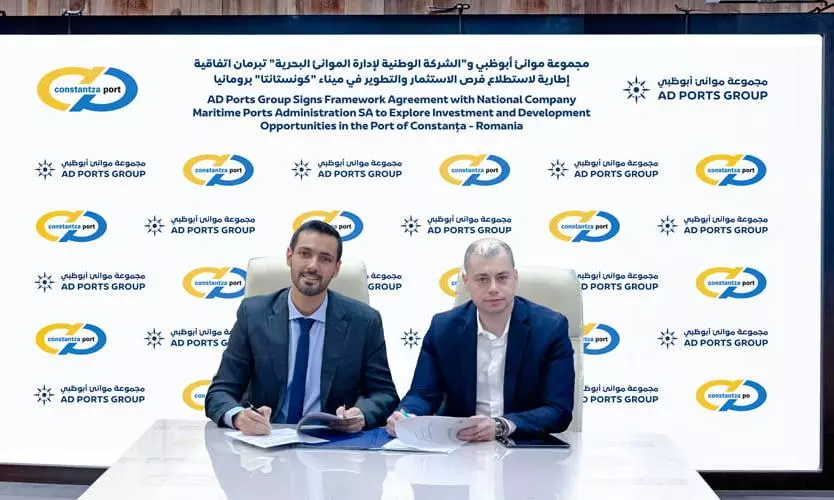
AD Ports Group has signed a framework agreement with the National Company Maritime Ports Administration SA to explore investment and development opportunities at the Port of Constanța in Romania.
The agreement establishes a platform for collaboration across multiple areas, including greenfield and brownfield port development, deployment of digital solutions, and sustainability initiatives such as renewable energy adoption, efficient waste management and emissions reduction.
Captain Mohamed Juma Al Shamisi, Managing Director and Group CEO of AD Ports Group, said the partnership reflects the strategic importance of the Black Sea port. “This agreement provides a framework for dialogue and cooperation with the Port of Constanța, one of the most strategically significant maritime hubs in the Black Sea region. Guided by the vision of our wise leadership in the UAE, we look forward to exploring opportunities that further strengthen the Group’s presence along the Middle Corridor, while supporting our Romanian partners in unlocking sustainable economic growth through enhanced connectivity and trade.”
Located on the Black Sea, the Port of Constanța is one of Europe’s largest ports and a key gateway for regional and international trade. In 2025, the port handled approximately 88 million tonnes of cargo, including liquid, dry and general cargo, along with around one million TEUs of container traffic.
Positioned at the mouth of the Danube–Black Sea Canal, the port serves as a multimodal hub connecting maritime, rail, road and inland waterway networks. It plays a critical role in facilitating trade flows across Eastern and Central Europe, including significant volumes of agricultural commodities such as grains and cereals.
The agreement aligns with AD Ports Group’s broader strategy to expand its footprint along the Middle Corridor, a trade route linking China and Europe via Central Asia. Over the past four years, the company has made a series of investments across the region, including launching the Gulf Link joint venture with KTZ Express, establishing an intermodal logistics hub in Tbilisi, and developing a grain terminal at Kuryk Port in Kazakhstan in partnership with SEMURG Invest LLP.
The group has also strengthened its presence in the Caspian region through joint ventures with Kazakhstan’s national oil and shipping companies, and expanded into Central Asia through a logistics partnership in Tajikistan.
The Constanța agreement is expected to support further integration of maritime and inland transport networks, enhancing trade connectivity between Asia and Europe.