
Deugro delivers massive INEOS cargo from Oman to Belgium
dteq Transport Engineering Solutions, alongside Deugro, successfully transported oversized lift equipment from Oman to Belgium for the INEOS Terminal expansion project.
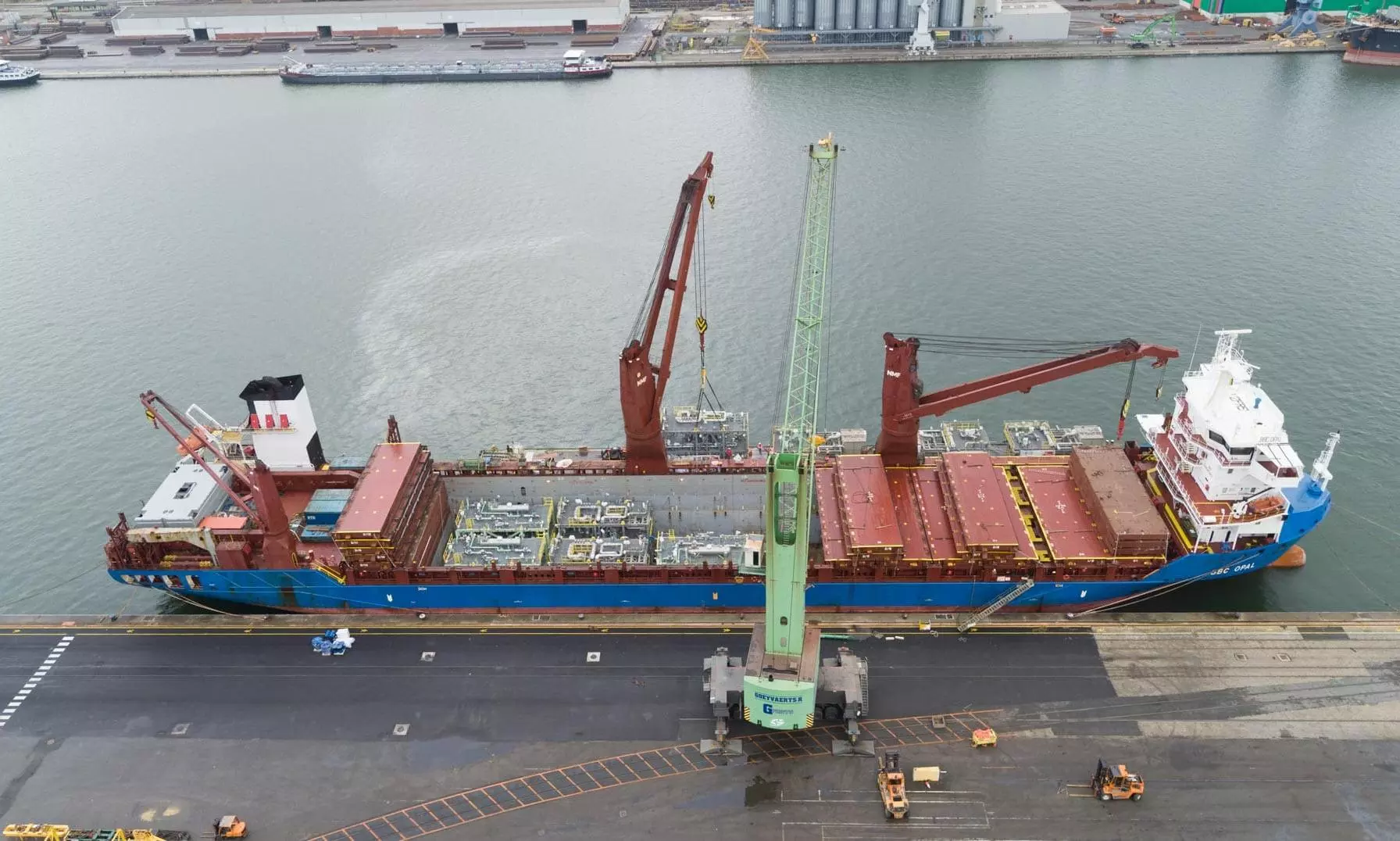
Deugro Belgium, Deugro Netherlands, and Deugro Oman, in partnership with dteq Transport Engineering Solutions, delivered over 7,324 cubic meters and over 1,441 cubic metric tons of critical equipment from Oman to Belgium for the INEOS Terminal Expansion project. The delivery was made on behalf of Deugro’s client, Worley.
The cargo consists of different oversized and heavy lift units that weigh approximately over 200 metric tons: three up to over 13.05 x 6.08 x 10.83-meter ethylene vessel skids, three up to over 13.50 x 6.00 x 9.90- meter refrigerant chiller skids, and three refrigerant compressor skids with volumes of up to over 14.35 x 7.00 x 7.45 meters.
The cargo units were transported by SPMTs and hydraulic trailers by the supplier in the Sohar Industrial Estate in Oman, however, it was observed by dteq that a few of the cargo units were positioned too close to the obstacles, avoiding self-loading for road transportation, during inspection at the manufacturer’s premises. This needed double handling that includes loading to a temporary transport solution, then moving to a space with enough maneuvering space for stooling down and later reloading, once approved for road movement with the final transport solution.
Once loaded and sealed on the specific trailers and SPMTs in agreement with the dteq’s loading and load-securing plans under deugro’s management and required inspection and testing, the components were moved to the intermediate storage at Soharport, which is nearly over 18.5 kilometers.
The units were decided to move during nighttime at a minimal speed, considering the size, weight, and local restrictions for public road transportation. Meanwhile, the Sohar Industrial Area and the Sohar Port were guarded by deugro’a local teams and the escort vehicles alongside Royal Oman Police, while they were moving on public roads. The route was assessed briefly prior to the movement to ensure a safe and trouble-free journey of the cargo units.
The cargo was moved according to the local requirements and restrictions as part of the regulations. Conventional trailers with four files x 15-axles and SPMTs with four files x 12-axles moved ethylene vessel skids, whereas the refrigerant compressor skids were carried by two field x 15-axle trailers and the refrigerant chiller skids by PMTs with four files x 12-axles. The movements were regulated under a maximum 14-metric-ton axle line road for road transportation.
All the units were successfully delivered after 15 days to the assigned storage area in collaboration with dteq. The refrigerant chiller skids remained unloaded until lifting operations started.
Once the vessel arrived, the cargo units were moved at walking speed to the loading quay. Also, considering the lifting height requirements for the highest cargo, the vessel was faced towards the pier along with the vessel cranes on the quay side, positioned in a way that made loading easier.
A preliminary survey was conducted to determine the safe loading operations. The survey reviewed operations executed earlier, at the same location, to ensure that the quay is safer for the quay movement within the vessel’s gears. Once the vessel was stationed at the pier, the lifting drawings and the impressive skids were lifted on board from the trailers through the vessel cranes, sidelining the lifting over cargo that was already stowed on board, keeping the changes down in the rigging setup, for different cargo.
Even though skids are designed with lifting lugs for 300-metric-ton shackles, six out of nine skids featured lifting lugs on the top, which were identified as a potential safety risk by Deugro and dteq during inspection.
Senior Naval Architect at dteq Transport Engineering Solutions, Giovanni Nigro said, “Working at a height of 12 meters with a shackle and pin weighing over 100 kilograms becomes challenging and dangerous. Therefore, we requested approval to use lower and lighter shackles to ensure easier and safer lifting operations. Because the lifting lugs could no longer be modified, and because the lifting operation had to comply with the DNV standard as required by the MWS, we immediately arranged for the design, manufacture, and procurement of a set of tailored spacer rings and sleeves for each cargo unit. These were pre-installed on the existing lifting lugs to compensate for the significant difference of over six millimeters between the lug and the designated rigging shackle pin diameters, thereby enabling the safe use of 120-metric-ton shackles. This equipment was installed on all cargo lugs as well as on the lifting beam lugs, and it remained on board to be used again at the POD during discharge”.
The process of securing cargo consisted of vertical H-beams, which were pressed all around the skids lower frame to protect horizontal movement. Simultaneously, wire lashing was utilised to secure cargo against tipping around vertical cargo columns featuring proper rubber material around the column edge to prevent chafing. Post loading and brief inspection, the Chief Mate, vessel Master, duegro, and the MWS, the vessel was prepared for a roughly 10,800 nautical-mile journey that took 38-day ocean voyage to the Port of Antwerp, Belgium via the Cape of Good Hope.
The vessel was moored after it arrived at the PSA Breakbulk terminal in Antwerp, with the cranes facing away from the quay due to the following vessel discharge by a double-banking lifting operation. Deugro Antwerp managed to secure two RO/RO flat-top pontoons, which were positioned beside the vessel one after another. The mooring arrangements confirmed the stability that led to the start of lifting operations. The significance of stability during cargo landing is non-negotiable, and continuous pontoon ballasting ensures the process.
The pontoons were pushed by a tug once the cargo units were safely lashed and offloaded at Sigelweg Quay, which is located four nautical miles away. However, Deugro arranged a floating crane as efficient equipment to discharge cargo units, because of the pier’s limited ground bearing capacity and maneuvering space. Deugro project managers involvement alongside dteq Transport Engineering Solutions, during the operation ensured safe and smooth execution.
Project Manager at Deugro Antwerp, Joost Maranus said, “Meticulous planning and preparation, combined with close and clockwork-like operational collaboration and communication between all partners, as well as the seamless coordination between on-site project management and transport engineering, made this project a success”.