
Egypt's food exports reach $2.4 billion in Jan-Apr
Egypt's food exports reached $2.4 billion in the first four months of 2026, up 7.1% year-on-year, driven by strong demand across Arab, European, and other markets.
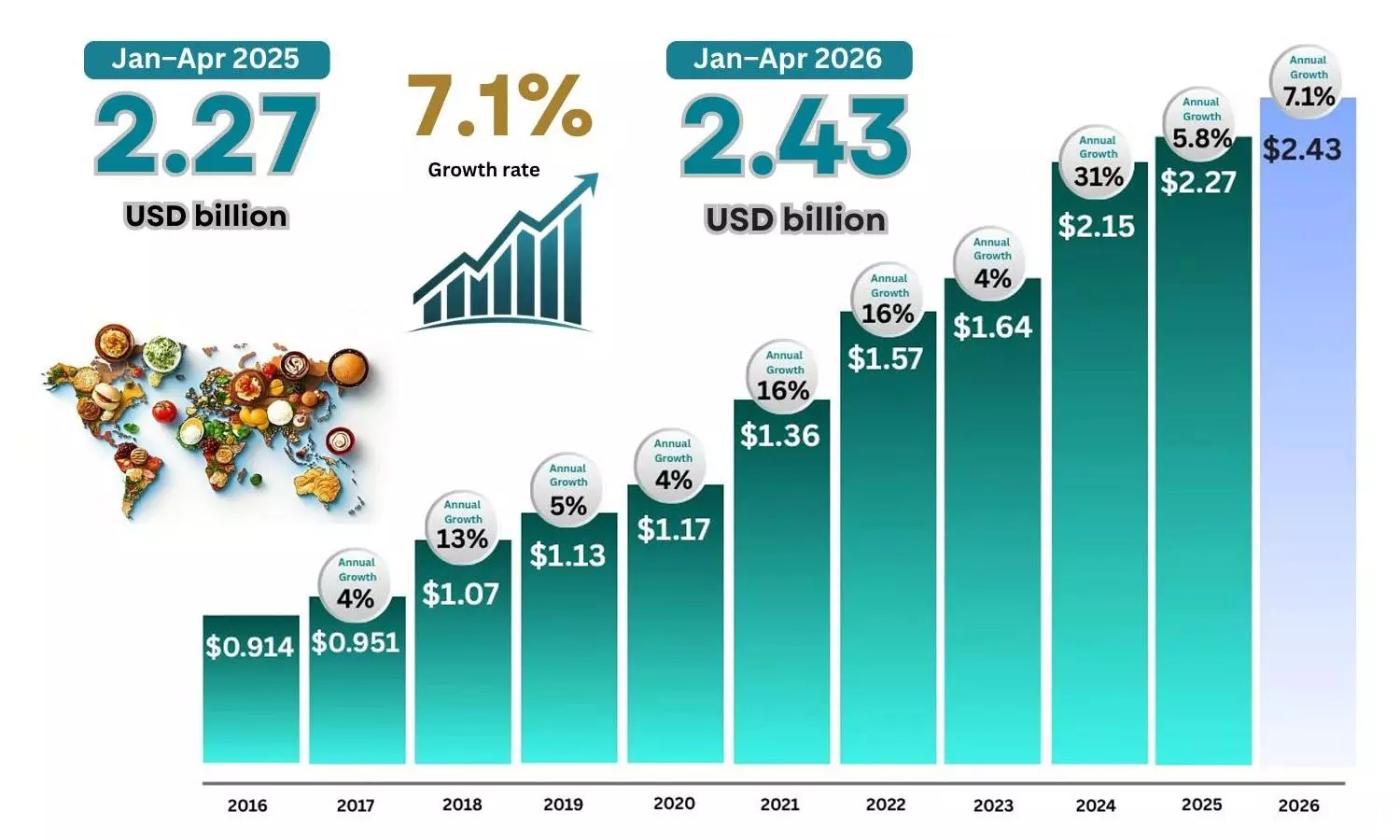
Egypt's food industries sector recorded steady growth during the first four months of 2026, with exports reaching $2.4 billion between January and April, according to figures released by the Food Export Council (FEC) on June 14.
The total represents a 7.1% increase over $2.2 billion for the same period in 2025, reflecting an additional $161 million in export revenues.
The FEC attributed the positive performance to the sector's continued competitiveness, efforts to diversify export destinations, and stronger penetration into both established and emerging markets despite ongoing global economic uncertainty and disruptions to international trade and supply chains.
Monthly export figures showed consistent growth throughout the period. Exports reached $536 million in January, compared with $531 million a year earlier, while February exports increased to $586 million from $532 million. In March, exports rose to $616 million, up from $578 million in the corresponding month of 2025.
April recorded the highest monthly export value during the four months, with shipments totaling $694 million, compared with $631 million in April last year, representing a 10.1% increase or an additional $64 million.
According to the Council, the results highlight sustained international demand for Egyptian food products and the ability of exporting companies to expand their presence in key global markets.
Arab countries remained the largest destination for Egyptian food exports, importing products worth $1.1 billion and accounting for 46% of total exports. The value of exports to the region increased by $39 million compared with the same period last year.
The European Union ranked as the second-largest market, with imports valued at $551 million, representing 23% of total exports. The bloc also recorded the strongest regional growth, with exports rising by $72 million, or 15%, supported by higher demand for products including frozen strawberries, olives, and edible oils.
Egypt's food exports to the United States increased by 11% during the first four months of 2026, reaching $160 million, according to the Food Export Council (FEC).
While exports to non-Arab African countries declined by 6% to $155 million, shipments to the rest of the world grew by 11% to $441 million, reflecting the sector's continued expansion into diverse international markets.
Saudi Arabia retained its position as Egypt's largest single export destination, with food exports rising 21% to $213 million, supported by strong demand for chocolate, beverage concentrates, dairy products, and animal feed. The United States ranked second with $160 million in imports, followed by Jordan, where exports climbed 22% to $110 million.
Spain recorded the strongest growth among Egypt's major export markets, with shipments surging 103% to $103 million. The increase was largely driven by higher exports of edible oils, olive oil, and processed olives.
Exports to the Netherlands rose 2% to $97 million, while shipments to Libya totaled $93 million despite a 23% decline. China continued to emerge as a promising market, with exports increasing 42% to $82 million, mainly due to higher frozen strawberry shipments.
Food exports to Palestine grew 47% to $81 million, while exports to Italy rose 10% to $78 million. Shipments to the United Arab Emirates remained largely unchanged at $76 million, and exports to Kazakhstan increased 17% to $46 million.
The United Kingdom and Iraq also posted strong gains. Exports to the UK jumped 61% to $61 million, while exports to Iraq rose 26% to $87 million, driven by increased demand for chocolate, tobacco products, fats, and oils.
Germany was among the few European markets to record a decline, with exports falling 14% to $56 million due to lower demand for frozen strawberries and processed agricultural products.
Among Arab and African markets, exports to Sudan dropped 16% to $107 million, while shipments to Lebanon declined 29% to $47 million. Exports to Somalia, Morocco, and Libya also registered notable decreases.
According to the FEC, the top 20 export destinations accounted for $1.7 billion, representing approximately 70% of Egypt's total food exports during the January-April 2026 period.